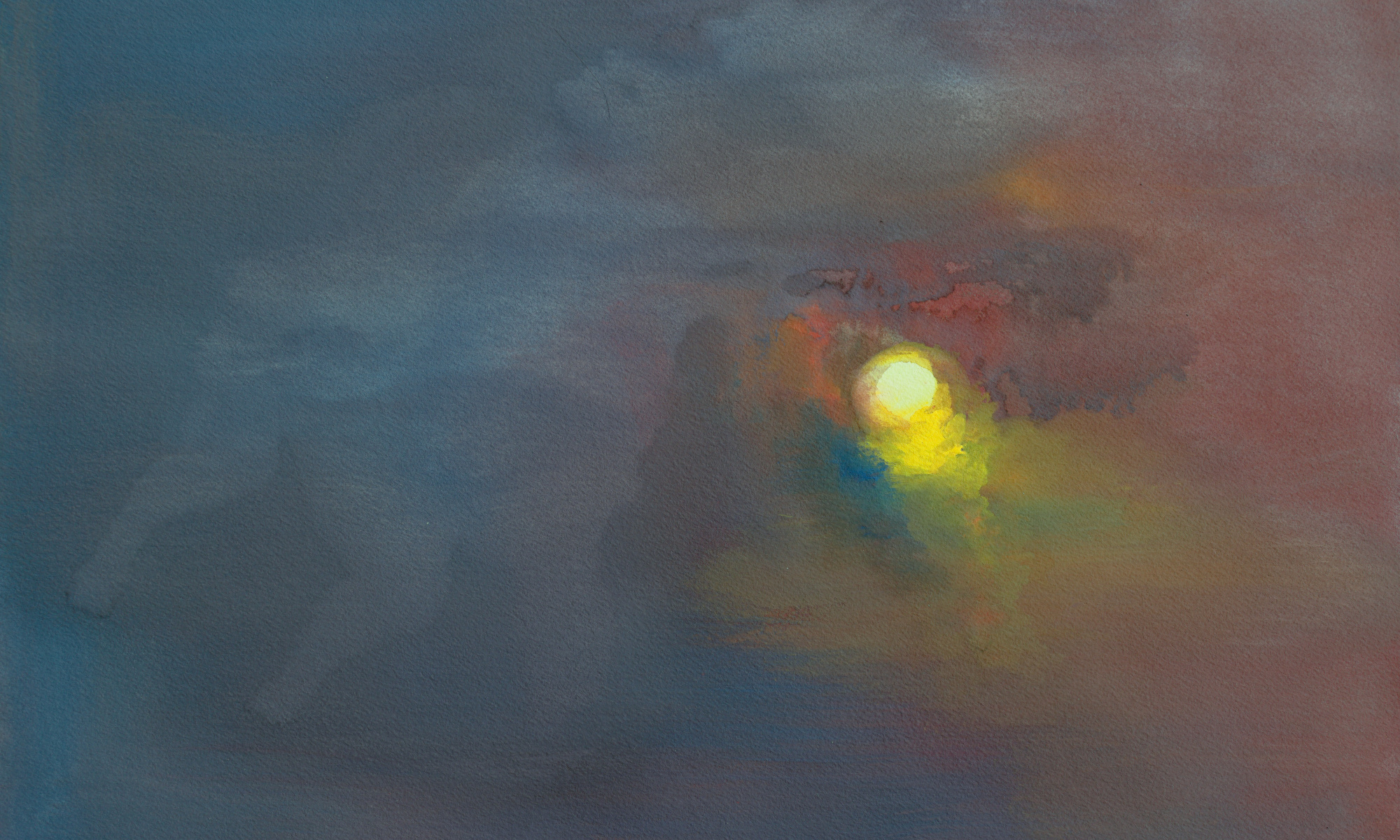
 I began writing “corona” in January 2020, as the year of the rat began, with friends in China on my mind. I began sharing it with a few friends in China and elsewhere near the middle of February, and one of them, Song Zijiang, who edits the Hong Kong poetry journal Voice & Verse, asked if he could include it in a special “virus” section planned for the next issue (No. 53, May 2020). I readily agreed. It is a fine journal, and I am always pleased to be part of it. I painted the nine images that accompany the sequence in this digital edition in February and March. I had the sonnet sequence in mind as I painted, but the paintings are not illustrations. I think of them as a second sequence in conversation with the first, both in conversation with the world. I am grateful to Song Zijiang, Tammy Ho Lai-Ming, and the editorial board of Voice & Verse for bringing the “corona” sequence to life in their journal and to Regina Schroeder for designing this beautiful digital edition that joins the sonnet sequence with the sequence of images and opens both to a wider conversation. The title refers to the form of the poem(s), but I chose both the form and the title with an eye on the virus that is sweeping the planet as I write this while sheltering in place in Chicago. Paying attention to the way a virus is named, the way it moves and multiplies, and the way(s) human hosts respond, I had language and boundaries in mind. The influence of Laurie Anderson’s brilliant performance piece and the William S. Burroughs image on which it draws is acknowledged in the epigraph. Readers will also notice echoes of Laozi, the Gospel of John, the Gospel of Luke, Shakespeare, and Gertrude Stein – all concerned with the power of names and the significance of naming. Language from documents associated with the naming of SARS-CoV-2 also surfaces. As the process of naming has moved from the body of scientific and medical literature to the body of political discourse, it has, like the virus, adapted to a new host. In the hands of political leaders already inclined to racism, xenophobia, and walls, the process threatens to become even more deadly than the virus itself. I hope both sequences contained in this edition give pause and contribute to a conspiracy – a breathing together – in which we acknowledge our fragility and practice compassion here, now, where we are.
lyrical abstraction in painting and poetry